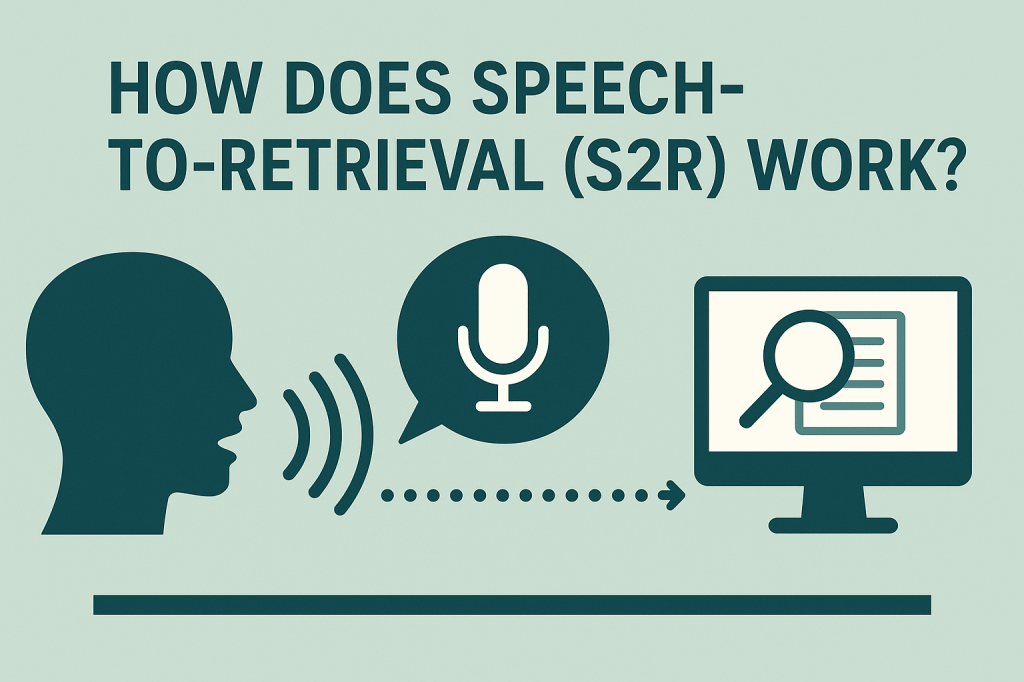
In the last decade, voice-based technologies have rapidly reshaped the way people interact with digital devices. From smartphones and smart speakers to virtual assistants and voice-enabled applications, speech has become one of the most natural and intuitive interfaces between humans and machines. While typing queries has been the traditional method of information retrieval, many users now prefer speaking to their devices due to convenience, speed, and ease of use. This shift has created a pressing demand for technologies that can understand and process human speech effectively.
One of the most transformative innovations addressing this demand is Speech-to-Retrieval (S2R). Unlike conventional search engines that rely on typed text, S2R focuses on understanding spoken language, converting it into meaningful queries, and retrieving the most relevant results from massive datasets. This approach not only improves accuracy but also reduces the time it takes to find information, creating a more seamless user experience.
S2R systems are particularly important in environments where hands-free operation is necessary, such as in smart homes, vehicles, or workplaces where multitasking is required. By intelligently interpreting voice commands, these systems help users achieve their goals without needing to type, click, or navigate multiple screens.
The development of S2R technology is tightly linked with advancements in artificial intelligence (AI), machine learning, and natural language processing (NLP). AI allows these systems to learn from interactions, recognize patterns, and continuously improve the accuracy and relevance of retrieved information. NLP ensures that the system not only recognizes words but also understands the context, intent, and meaning behind a query.
For those interested in exploring the technical details and the potential of S2R in modern applications, you can refer to this comprehensive guide on Speech-to-Retrieval by TopDevelopers.
In this article, we will delve deep into how Speech-to-Retrieval works, the steps involved in processing voice queries, the role of AI and databases, and the future potential of this technology in revolutionizing voice search and digital interactions.
How Speech-to-Retrieval (S2R) Works
1. Speech Input Processing
The first and most crucial step in any Speech-to-Retrieval system is processing the spoken input. Before a system can retrieve relevant information, it must accurately interpret the user’s speech. This step is handled primarily through Automatic Speech Recognition (ASR), a technology that converts spoken language into written text. ASR is the backbone of S2R, as the quality of the retrieved results depends heavily on how precisely the speech is transcribed.
Modern ASR systems rely on advanced algorithms and deep learning models. When a user speaks, the audio is captured and broken down into smaller sound segments called phonemes. The system then compares these phonemes to known patterns in its trained database to determine the most likely words and phrases. This process may seem instantaneous, but it involves complex signal processing, feature extraction, and probabilistic modeling behind the scenes.
Some key features of speech input processing include:
- Noise Handling: Real-world environments are rarely quiet. Background sounds, overlapping conversations, and echo can interfere with speech recognition. S2R systems use noise-cancellation and filtering techniques to isolate the speaker’s voice, improving transcription accuracy.
- Accents and Dialects: People speak with different accents, pronunciations, and regional dialects. A robust S2R system is trained on diverse datasets, allowing it to understand a wide range of linguistic variations.
- Continuous Speech Processing: Unlike single-word commands, most natural speech involves continuous sentences. ASR models segment speech into meaningful units while accounting for pauses, intonation, and speech patterns to preserve context.
- Homophones and Contextual Ambiguity: Words that sound alike but have different meanings, such as “write” and “right,” require contextual understanding. The system uses surrounding words and later semantic analysis to resolve these ambiguities.
For example, if a user says, “Find the nearest coffee shop that is open now,” the ASR system first transcribes the audio into text. It must capture not only the words but also maintain the order and meaning so that the next steps in retrieval can correctly interpret the user’s intent. Any errors in transcription at this stage could lead to irrelevant or incomplete search results.
Additionally, ASR models often incorporate real-time learning. They can adapt to a user’s voice, pronunciation, and commonly used phrases over time, improving accuracy for frequent queries. This adaptive capability is particularly valuable for applications like virtual assistants, smart devices, or customer service bots, where repeated interactions help refine performance.
In essence, the speech input processing stage transforms human voice into a machine-readable format while preserving meaning and context, laying the foundation for the subsequent retrieval and AI-driven analysis.
2. Retrieval Mechanism
Once a user’s speech has been accurately transcribed into text, the next critical step in Speech-to-Retrieval (S2R) is the retrieval mechanism. This stage determines which results or responses the system presents to the user. Unlike traditional keyword-based searches, modern S2R systems rely heavily on semantic understanding and Natural Language Processing (NLP) to comprehend the user’s intent and context.
Semantic Search
Semantic search goes beyond matching individual keywords in a query. Its goal is to understand the meaning behind the words. For example, if a user says, “Show me vegan restaurants near the river,” a keyword-based search might return any content with the words “vegan,” “restaurants,” or “river.” However, semantic search understands the intent: the user is looking for restaurants that serve vegan food and are located near a river. By analyzing the relationships between entities, semantic search delivers more precise and contextually relevant results.
Semantic search leverages advanced AI models to encode both the query and the potential results into numerical vectors that represent meaning. These vectors are then compared to identify the closest matches, ensuring the retrieved results align with the user’s intent rather than just the literal keywords.
Natural Language Processing (NLP)
NLP is essential for interpreting the structure, intent, and nuances of human language. It enables S2R systems to detect entities, relationships, and contextual cues. Key functions of NLP in S2R include:
- Entity Recognition: Identifying relevant objects, places, people, or concepts in the query, such as “vegan restaurants” or “river.”
- Intent Detection: Understanding the user’s goal, such as finding locations, getting recommendations, or asking for information.
- Context Understanding: Interpreting nuances like time sensitivity, preferences, or comparative phrases, e.g., “best vegan restaurant open now.”
- Synonym and Variation Handling: Recognizing alternative phrases or words that mean the same thing, such as “cafe” instead of “coffee shop.”
By combining entity recognition, intent detection, and context analysis, NLP ensures that the system interprets queries in a human-like manner, making the retrieval process smarter and more intuitive.
Ranking and Relevance
After identifying potential matches, the system must rank them based on relevance. This step ensures that the most appropriate results are presented first. Ranking considers multiple factors:
- Query-Result Similarity: How closely the result matches the meaning and context of the query.
- User Preferences: Personalization based on previous searches, location, or behavior.
- Recency and Popularity: Prioritizing results that are more recent or widely used.
- Contextual Relevance: Ensuring the results make sense in the current situation, such as time-sensitive queries or local context.
For instance, if a user asks, “Find open vegan restaurants nearby,” the system considers not only which restaurants serve vegan food but also which ones are currently open and close to the user’s location. This ensures the results are actionable and relevant, improving user satisfaction.
Together, semantic search, NLP, and ranking form the core of the retrieval mechanism in S2R. They bridge the gap between human language and machine understanding, allowing systems to respond intelligently to natural voice queries.
3. Integration with AI and Databases
After processing the speech input and understanding the user’s intent through semantic search and NLP, the next critical stage in Speech-to-Retrieval (S2R) is the integration with AI models and databases. This stage ensures that the system can provide accurate, personalized, and actionable results by leveraging structured knowledge and intelligent algorithms.
Machine Learning and AI
Artificial intelligence plays a vital role in enhancing the performance of S2R systems. Machine learning algorithms analyze user interactions to improve accuracy and relevance over time. These models can adapt to individual user behavior, learning preferred responses, common queries, and frequently accessed information.
For example, if a user repeatedly searches for vegan restaurants in a particular city, the system can prioritize similar results for future queries. Similarly, AI models can recognize speech patterns, accents, and pronunciation variations, adapting to each user’s voice to improve recognition accuracy. Over time, this continuous learning process makes the S2R system smarter and more personalized.
Databases and Knowledge Graphs
Databases are the foundation of retrieval in S2R systems. They store vast amounts of structured and unstructured data, which the system searches to find relevant results. Knowledge graphs enhance this process by connecting entities, relationships, and facts. They allow the system to understand not just isolated pieces of information, but how they relate to each other.
- Example of Knowledge Graph: In response to “Show me vegan restaurants near the river,” a knowledge graph connects the concepts of restaurants, vegan food, and geographic locations to provide precise recommendations.
- Unstructured Data Handling: AI can extract information from articles, reviews, social media, and other sources to expand the scope of results beyond traditional databases.
Real-Time Adaptation
Integration with AI and databases also allows S2R systems to respond in real-time. Once a query is processed, AI models analyze potential results, rank them, and deliver a response almost instantaneously. This real-time capability is essential for applications like virtual assistants, smart home devices, and customer support bots, where users expect immediate answers.
For instance, if a user asks, “Which vegan restaurant nearby is open now and has good reviews?” the system evaluates live data from multiple sources, applies AI-driven ranking based on relevance and quality, and provides a personalized recommendation within seconds. Without this integration, such dynamic and context-aware responses would not be possible.
Challenges and Considerations
Despite the advantages, integrating AI and databases in S2R systems comes with challenges:
- Data Privacy: Voice data is sensitive, so secure storage, encryption, and compliance with data protection laws are critical.
- Scalability: Systems must handle large volumes of queries and data without compromising performance.
- Data Accuracy: AI relies on high-quality data; inaccuracies in databases or knowledge graphs can lead to incorrect results.
Continuous improvements in AI, real-time data processing, and robust database management are addressing these challenges, enabling S2R systems to deliver accurate, reliable, and personalized voice search experiences.
Conclusion
Speech-to-Retrieval (S2R) is transforming the way humans interact with technology by enabling accurate, intelligent, and highly efficient voice-based search. By combining speech recognition, semantic understanding, and AI-driven integration with databases and knowledge graphs, S2R systems can interpret natural language, understand user intent, and deliver relevant results almost instantaneously.
The benefits of S2R extend far beyond simple voice search. It enhances accessibility for people with disabilities, provides hands-free operation in vehicles and workplaces, and enables smarter digital assistants capable of handling complex, multi-step queries. Users no longer need to memorize exact keywords or navigate multiple screens; they can simply speak naturally, and the system interprets their needs accurately.
From a business perspective, S2R offers significant opportunities. Companies can leverage this technology to improve customer service, provide personalized recommendations, and deliver context-aware interactions. For example, a restaurant chain could use S2R to answer voice queries about menu items, operating hours, and nearby locations in real-time, creating a seamless user experience.
As AI and NLP technologies continue to evolve, the potential of S2R systems will expand further. Future developments may include enhanced understanding of emotional tone, predictive voice responses based on user behavior, and more sophisticated multi-lingual capabilities. This evolution promises a future where human-computer interaction is even more natural, intuitive, and context-aware.
For businesses and developers looking to explore S2R technology, partnering with experienced AI solution providers is crucial. A curated list of specialized companies can be found at AI development companies, helping organizations implement voice-based solutions efficiently and effectively.
In conclusion, Speech-to-Retrieval is not just an incremental improvement in search technology; it represents a paradigm shift in how humans communicate with machines. By transforming spoken words into precise, actionable results, S2R is setting the stage for a future where voice will be a primary interface for digital interactions, enhancing both convenience and user experience across industries.
 Think AI
Leave a comment